Buyback and valuation
Selling Gold Jewellery and Scrap: How Payouts Work
| Spec | Detail |
|---|---|
| Basis | Priced per gram of fine-gold content after karat testing, net of stones, solder and clasps |
| Typical payout | 40 to 92% of melt value; reputable buyers pay 80 to 92% |
| Per-oz equivalent | Roughly $1,719 to $3,954 at $4,298/oz spot, depending on buyer and karat |
| What is tested | Karat (fineness) by XRF or acid, then fine-gold weight |
| Paperwork | ID and AML documentation required by any legitimate buyer |
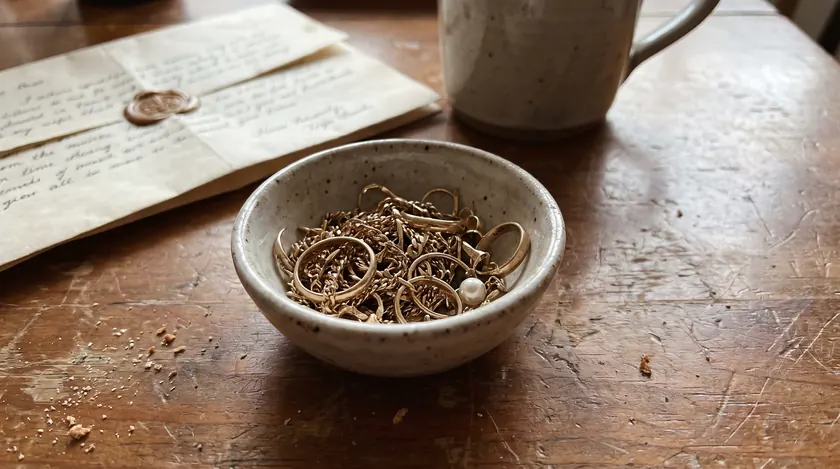
Almost every family in Dubai, Singapore or Hong Kong has a drawer, a safe deposit box or a jewellery roll with gold in it that nobody currently wears: a mother's bangles, a wedding necklace nobody's daughter wants in that style, a religious pendant with a broken clasp. None of it is bullion. All of it has a melt value, and that value is calculable the moment someone tests the karat.
The number that comes back from that test is rarely the number a seller expects, because the gap between a fair buyback quote and a lowball one is enormous, and almost nobody sees both quotes before choosing a buyer.
How a scrap payout is actually calculated
The formula is simple: fine-gold weight, times spot, times the payout percentage the buyer is offering, and that last number is the one buyers are least likely to put in writing unless you ask.
Across our three hubs, payouts run anywhere from 40% to 92% of melt value depending on who is buying. Reputable, assay-first dealers pay 80 to 92% of melt. Informal cash-for-gold kiosks and instant-cash counters routinely pay toward the bottom of that range, sometimes below it. The spread is the entire negotiation, and it is exactly why getting two or three quotes before selling is not optional.
Here is the arithmetic on a real example. Take 100 grams of 18k jewellery. 18k gold is 75% fine, so that is 75 grams of pure gold content once stones, solder and clasp weight are excluded. At $4,298 per troy ounce spot, that is about $138.18 per gram of fine gold, so 75 grams comes to roughly $10,364 in melt value. A reputable buyer paying 80 to 92% of melt offers somewhere between $8,291 and $9,535 for that same 100 grams. A buyer paying nearer 40% of melt, the bottom of the range we see quoted, offers around $4,146, less than half the honest number for identical metal.
Our assay-first process
We test before we quote, not the other way round.
- Independent karat test by XRF or acid, on the piece itself, before any number is discussed
- Fine-gold weight calculated net of stones, solder and clasps, shown to you as a separate figure
- Payout quoted as an explicit percentage of that day's live spot, in writing, before you agree to anything
- Room to compare our quote against two or three others before deciding
- Transparent per-gram schedule by karat, so 18k, 22k and 24k pieces are priced on a schedule you can see
- ID and AML paperwork completed properly, a legal requirement for any legitimate buyer in Dubai, Singapore or Hong Kong, not paperwork we add for effect
Prefer to just ask? Send a short message, we reply the same day.
Get a valuationWhat you should not sell as scrap
Melt-value pricing suits a broken chain or an out-of-style bangle. It is the wrong tool for two categories of item that reach our door as often as plain jewellery does.
Signed pieces from a recognized maker, Cartier, Van Cleef, Bulgari and similar houses, carry design and brand value that a per-gram melt quote ignores completely. The same goes for anything with period craftsmanship or a maker's mark you do not recognize: it is worth a second look before it goes on the scale.
Old coins are the other category, and they turn up in family gold more often than people expect. A Gold Sovereign or a pre-1932 issue is not scrap. Our numismatic coins page explains why melt is the floor on a historic coin, never the ceiling, and grading it before selling can change the outcome by a large multiple. If you inherited a mixed lot, jewellery and coins together, ask us to separate the two before anything is quoted as scrap. Our guide to selling inherited gold in Dubai covers the paperwork side of exactly this situation.
Frequently asked questions
How is my gold jewellery actually priced?
We test the karat with XRF or acid, weigh the fine-gold content net of stones and findings, and quote that weight as a percentage of the day's live spot price, in writing, before you agree to sell.
Why do quotes vary so much between buyers?
Payouts across Dubai, Singapore and Hong Kong range from about 40% to 92% of melt value. Reputable, assay-first dealers sit at 80 to 92%. Instant cash-for-gold kiosks tend toward the bottom of that range. The difference is the buyer's margin, not the gold.
Should I get more than one quote?
Yes. Because the payout percentage varies this much between buyer types, two or three quotes on the same tested weight is the only way to know whether an offer is fair.
What if some of my gold is coins, not jewellery?
Old coins, sovereigns especially, can carry numismatic value well above melt. We separate coins from jewellery before quoting anything, and grade coins separately rather than melting them into the same per-gram number.
What ID or paperwork do I need to sell?
Legitimate buyers in all three hubs are required to complete ID verification and anti-money-laundering checks before any transaction, regardless of the amount. Bring photo ID and, for larger or inherited lots, any proof of ownership you have.
Have gold jewellery or scrap to sell?
Bring it in for a karat test. We quote the payout percentage in writing before you decide anything.
Get a valuation